Case Study: Turning High Traffic Into Sales for an Ecommerce Furniture Brand
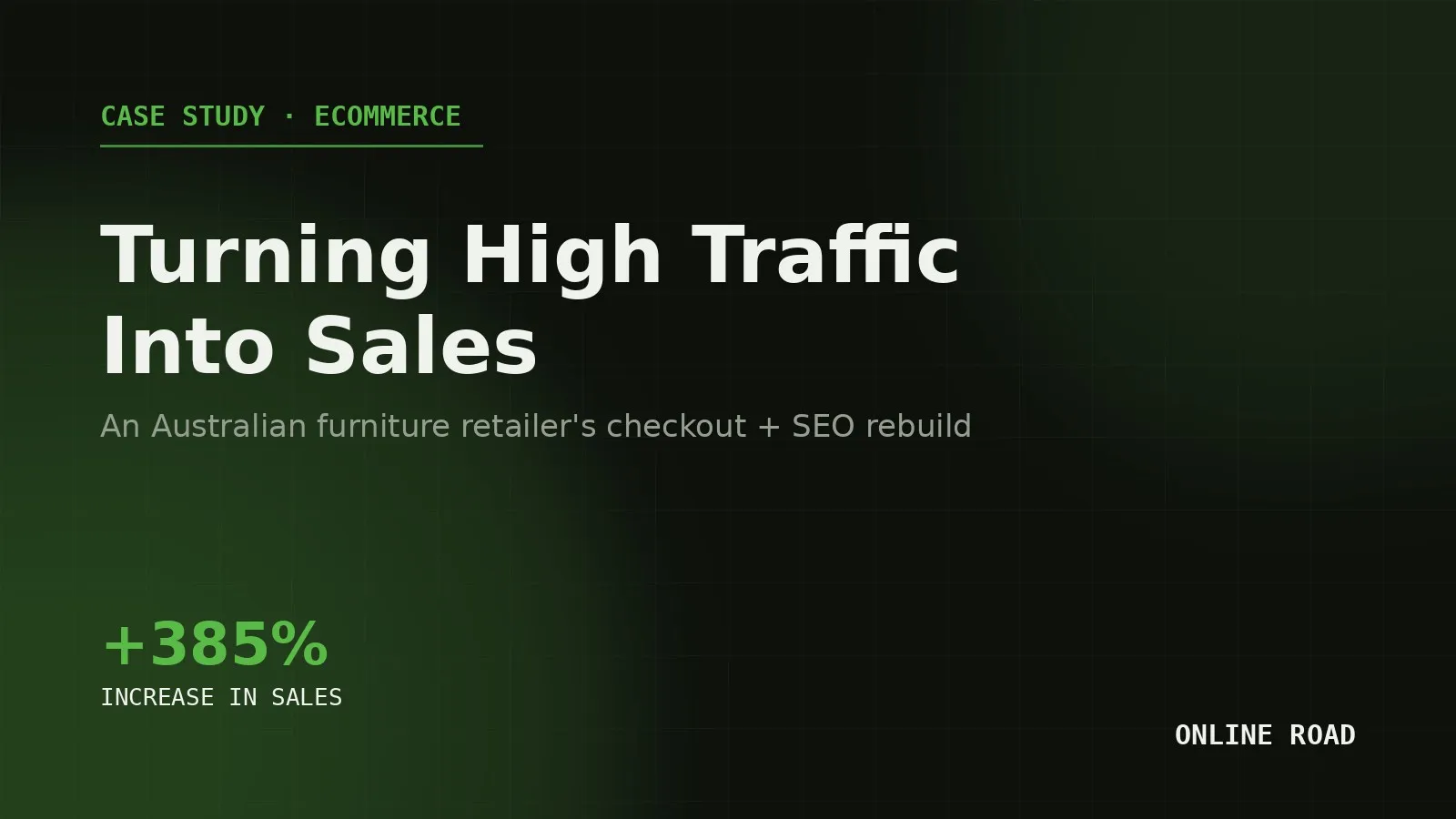
Most ecommerce case studies either talk about traffic or talk about conversion rate, rarely both at once. That is a gap, because for a store with real visitors already arriving, the traffic was never the problem. This case study covers an Australian furniture retailer that had strong traffic and a checkout quietly losing a large share of it, and the specific SEO and conversion fixes that turned that traffic into a 385% increase in sales.
The brand and the starting problem
Furniture Forum is an online retailer of modern furniture, competing in one of the most saturated ecommerce categories in Australia: every major retailer, several international players and countless smaller stores all fight for the same searches. The business had a real advantage most new ecommerce stores do not: genuine, steady website traffic. What it did not have was a checkout that kept hold of that traffic once a visitor decided to buy, and rankings for the high-value product keywords that would have brought in more buyers at that same intent level.
That combination, decent traffic and a leaking checkout, is one of the most common and most expensive problems in ecommerce, precisely because it is invisible in the metric most store owners watch first. Session counts and visitor numbers can look healthy for months while a sizeable share of buyers quietly give up at the final step, and nothing in a standard analytics dashboard flags that as the cause.
What actually moved: SEO, checkout and paid working together
The campaign ran three channels in parallel, with SEO, a checkout and site rebuild, and paid advertising across Google Ads and Meta Ads all tracked back to actual sales rather than sessions or clicks.
SEO: targeting the searches buyers actually use before paying
Rather than optimising broadly for “furniture” or “modern furniture,” the SEO work targeted the specific, high-intent product searches a buyer closer to purchase actually types: a named product type combined with a location or a clear qualifier, the exact kind of search where someone has already decided what they want and is comparing where to buy it. On-page content, site structure and backlinks were all built around these terms rather than spread thin across the broadest possible category language.
That specificity is what delivered the standout result: Furniture Forum reached the number one organic position for “Modular Couch Sydney” and for “Rocking Chair,” both fiercely competitive terms in a crowded retail category. Ranking first for a specific product a buyer is actively searching for is worth more than ranking lower for a dozen generic ones, because the buyer who typed that exact phrase is far closer to purchasing than someone browsing a category page.
The checkout rebuild: removing the friction that was losing sales
Alongside SEO, the checkout experience was rebuilt to remove the friction causing visitors to abandon before paying. This is the part of the campaign that mattered most for the headline result, because it did not depend on new traffic arriving; it converted more of the traffic already on the site into completed sales.
This is a well-documented problem industry-wide, not specific to this one store. Baymard Institute’s research, aggregating more than 50 independent studies, puts the average ecommerce cart abandonment rate at around 70%, and identifies the most common, fixable causes: unexpected extra costs appearing late in checkout, a process that feels too long or complicated, slow delivery estimates, and sites that force a new account before a buyer can pay. None of those require a discount or a traffic increase to fix, only a checkout that gets out of the buyer’s way.
Paid advertising: putting the best products in front of ready-to-buy shoppers
Google Ads and Meta Ads campaigns ran specifically to put Furniture Forum’s best-performing products in front of shoppers who had already shown buying intent, rather than running broad brand-awareness campaigns. With the checkout now converting a higher share of visitors, paid spend generated more completed sales per dollar than it would have against the original checkout, which is a detail that is easy to miss when SEO, paid and conversion work are planned separately instead of together.
The result
- +385% increase in sales
- #1 organic ranking for “Modular Couch Sydney”
- #1 organic ranking for “Rocking Chair”
As the Furniture Forum team put it:
“I approached Online Road when my website wasn’t taking off. Within two weeks of bringing them onboard, my sales rapidly multiplied and my social media presence grew.”
Furniture Forum
You can see the full breakdown on the Furniture Forum case study.
The framework: a traffic-to-sales checklist for ecommerce stores
Strip away the furniture specifics and this case study is a repeatable checklist for any Australian ecommerce store that has traffic but is not converting it at the rate it should.
- Are you ranking for specific, high-intent product terms, or only broad category terms? A buyer searching a named product is closer to purchasing than one browsing a generic category page. If your SEO content only targets the broadest industry terms, you are competing against every retailer in the country for traffic that converts at a lower rate anyway.
- Does your checkout show the full price early, not at the final step? Baymard’s research puts unexpected extra costs at checkout as the single biggest reason shoppers abandon a cart. Shipping, taxes and fees shown upfront lose far fewer buyers than the same costs revealed on the last screen.
- Can a buyer check out as a guest? Forcing account creation before payment is one of the most common, and most avoidable, reasons a ready-to-buy visitor leaves instead of finishing an order.
- How many steps does your checkout actually take? Every additional field, page or confirmation step is another point where a buyer can lose momentum and close the tab. Audit your own checkout as if you were buying something, counting every click from cart to confirmation.
- Is your paid spend going to your best-converting products, or spread evenly? Once checkout friction is fixed, paid campaigns aimed at proven, high-intent products return more sales per dollar than broad campaigns spread across the full catalogue.
If most of these are already in good shape, your gap is more likely to be SEO targeting than conversion. If several are missing, the checkout is usually the faster and cheaper fix, and the one that pays back immediately on traffic you are already generating or paying for.
Where ecommerce stores typically leak sales beyond the checklist
A few further patterns show up repeatedly in stores stuck with decent traffic and a conversion rate that will not move.
- Treating SEO and conversion as separate projects run by separate teams or agencies. When the two are not coordinated, a store can rank well and still convert poorly, or convert well on a small slice of traffic that never grows. Running SEO and conversion work together, as happened here, is what compounds the result rather than just adding two separate improvements.
- Mobile checkout treated as an afterthought. Most ecommerce traffic now arrives on mobile, and a checkout that was designed for desktop first tends to carry over small frictions, cramped form fields, hidden buttons below the fold, that cost more sales on mobile than the same issues would on desktop.
- No urgency or trust signals near the buy button. Real stock indicators, clear return policies and visible security signals reduce hesitation at the exact moment a buyer is deciding whether to commit, particularly for a higher-consideration purchase like furniture.
- Paid campaigns running to a homepage instead of the specific product page. Sending a shopper who searched for a named product to a general homepage adds an extra, unnecessary step before they find what brought them there in the first place, and every extra step costs conversions.
Why this matters beyond furniture
The mechanics here generalise to any Australian ecommerce store competing in a crowded category: high-intent SEO plus a checkout that removes friction plus paid spend aimed at what already converts, all measured against actual sales rather than traffic. Golf Paradise, another online retailer, took the same combined approach from a cold start to $300k in monthly revenue within its first month. Our guide to what a slow, friction-heavy website costs in lost sales covers the performance side of this same problem in more detail, and our local keyword research guide covers the same high-intent targeting principle behind point one above, applied to service businesses.
Our web design and development team rebuilds sites and checkouts for Australian ecommerce stores on fast, conversion-focused foundations, and our case studies page shows the same SEO-plus-conversion approach working across other retail, service and local businesses.
Where to start if you run an ecommerce store
You do not need to rebuild everything at once. The fastest, clearest read usually comes from auditing your checkout against the five-point list above first, since fixes there pay back on traffic you already have, before expanding SEO targeting to the specific, high-intent product terms your buyers are already typing.
If you want a second set of eyes on where your own store is actually losing sales, book a free strategy call and we will walk through your checkout and SEO targeting against this exact framework.