How to Get Your Business Recommended by ChatGPT: A 30-Day Checklist
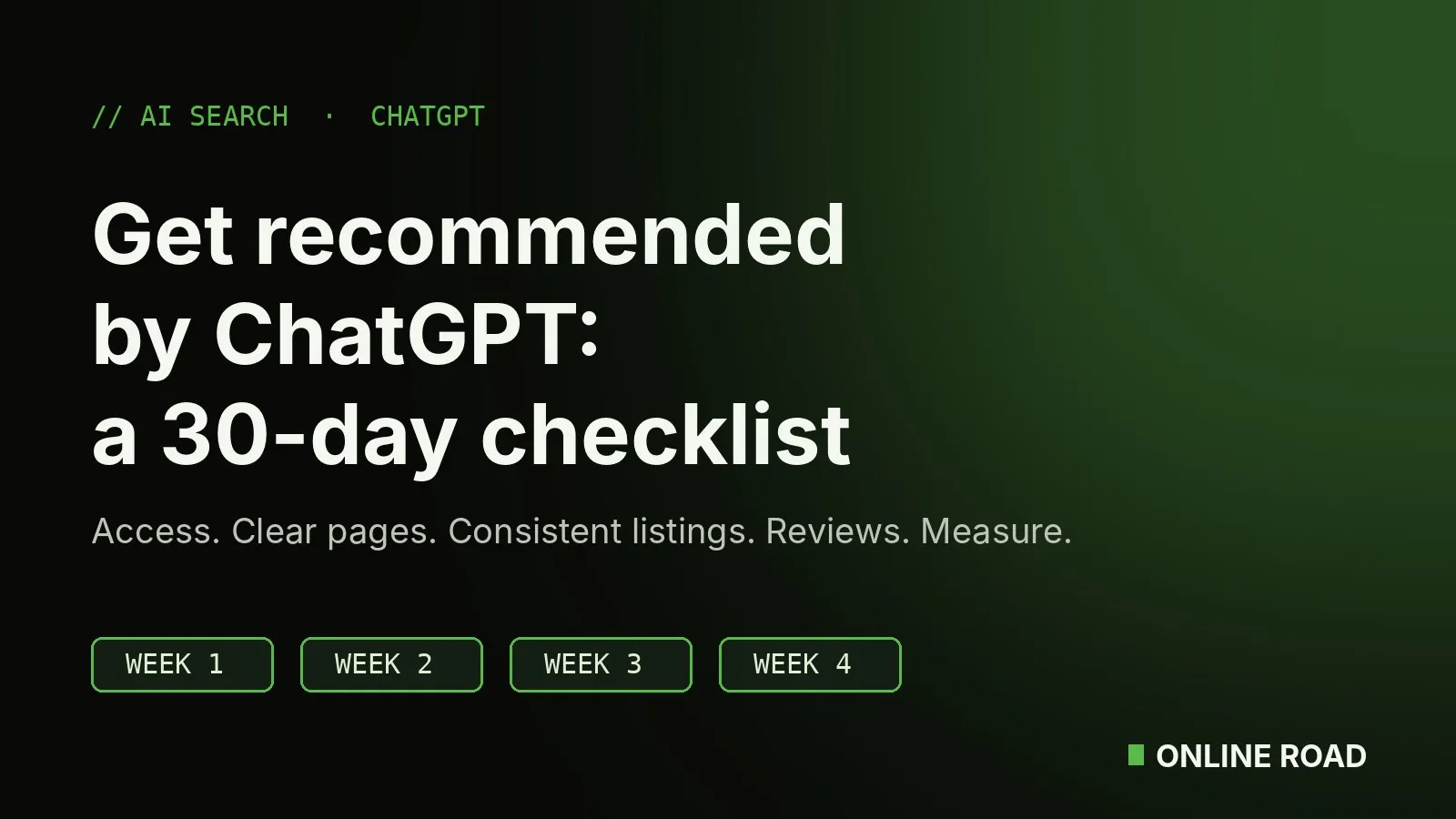
To get your business recommended by ChatGPT, you need four things in place: OpenAI’s crawler must be able to read your site, your pages must say plainly what you do and where, your details must match across the web, and independent sources must back you up. None of it is a trick, and all of it can be started in the next 30 days.
This checklist breaks that work into four weeks for an Australian local or service business. It is written for owners and marketing managers who want to do the groundwork themselves, or who want to know what a good agency should be doing for them. If you would rather have it done for you, that is what our ChatGPT SEO service covers.
How does ChatGPT decide which businesses to recommend?
When someone asks ChatGPT “who is a good physio in Parramatta” or “best electrician near Newcastle”, it either answers from what it learned in training or searches the live web and cites what it finds. For local, current questions, it increasingly searches.
That gives you two jobs. First, be reachable: OpenAI’s crawler documentation says sites that opt out of OAI-SearchBot will not be shown in ChatGPT search answers. Second, be credible: once ChatGPT can see you, it has to find enough consistent evidence to name you with confidence.
The best data we have on that second part comes from a 2026 Insites study of 10,000 US local businesses. It found:
- Businesses surfaced by both ChatGPT and Perplexity averaged about 133 Google reviews. Businesses surfaced by neither averaged about 11.
- A business’s own website was the most cited source.
- Businesses in Google’s local pack were recommended far more often than those outside it.
It is a vendor study of US businesses and shows correlation, not cause. But it matches what most AI search research keeps finding: AI recommends businesses that are easy to find and that other sources agree about.
Before you start: the 30-minute baseline
You cannot tell whether anything worked without a “before” picture. Do this on day one.
- Write 10 prompts your customers would actually type. Mix three kinds: category (“best plumber in Penrith”), problem (“my hot water system is leaking, who can fix it today in western Sydney”) and brand (“is [your business] any good”).
- Run each one in a fresh ChatGPT chat, ideally logged out or in a temporary chat, so past conversations do not colour the answer.
- Record the result in a simple spreadsheet: recommended, mentioned, cited as a source, or absent. Note who was named instead and which websites ChatGPT linked to.
Those linked websites are gold. They are the directories, review sites and local pages ChatGPT trusts for your category. They become your target list in week three.
Answers change between sessions, so do not panic over one result. You are looking for the pattern across all 10.
Week 1: make sure ChatGPT can read your site
Most of this week is technical, and most of it is quick. Many Australian sites block ChatGPT without the owner knowing.
Check OpenAI’s crawlers can get in
OpenAI runs three crawlers, and each does a different job:
- OAI-SearchBot decides whether your pages can appear in ChatGPT search answers. This is the one that matters most.
- ChatGPT-User fetches a page when a user’s request needs it, such as when someone pastes your link.
- GPTBot collects content that may be used for training. OpenAI says this setting is independent, so you can block training and still appear in search.
Run your domain through our free ChatGPT crawler checker. It tests all three, shows the exact robots.txt line responsible, and checks whether a firewall is quietly blocking them even when robots.txt allows them. For a wider test across more than 20 AI crawlers, use the AI crawler checker.
If you want to allow search but block training, your robots.txt can look like this:
User-agent: OAI-SearchBot
Allow: /

User-agent: GPTBot
Disallow: /
OpenAI says robots.txt changes take about 24 hours to affect search.
Check your content is in the HTML
A 2024 analysis by Vercel found that OpenAI’s crawlers fetch JavaScript files but do not run them. If your services, prices or locations only appear after scripts load (common with some site builders and booking widgets), ChatGPT may see an empty page.
A quick test: open your service page, view the page source, and search for a sentence from the page. If you cannot find it, neither can ChatGPT.
Week 1 checklist
- OAI-SearchBot allowed in robots.txt
- No firewall, CDN or security plugin blocking AI crawlers
- Key service and location content visible in the page source
- Site indexed in both Google Search Console and Bing Webmaster Tools
That last item matters because AI assistants lean on search engines when they browse. OpenAI’s own publisher guidance refers to third-party search providers, and Microsoft says Copilot grounds its web answers in Bing. Being properly indexed in both costs nothing.
Week 2: make your pages easy to quote
Being readable makes you eligible. Being recommended depends on whether ChatGPT can pull a clear, confident answer from your pages.
One page per service, per place
Vague “we do everything” pages give ChatGPT nothing to match. If you are a plumber covering Penrith, Blacktown and Parramatta, a single “Services” page is far weaker than a page for hot water repairs and a page for each area you genuinely serve.
Write facts, not slogans
Compare these two lines:
- “We’re passionate about delivering exceptional outcomes for our valued clients.”
- “We are a licensed plumbing business in Penrith, operating since 2011, offering same-day hot water repairs across western Sydney, seven days a week.”
The second one is quotable. It answers who, what, where and how long, in one sentence. Go through your homepage and top service pages and add a short, plain summary like this near the top of each.
Add an FAQ that matches real prompts
Use the problem prompts from your baseline as headings. “Can you replace a hot water system on the same day in Blacktown?” followed by a direct two-sentence answer is exactly the kind of passage AI assistants lift. Our guide to structuring content for AI search goes deeper on format.
Mark it up with schema
LocalBusiness schema states your name, address, phone, hours, service area and reviews in a format machines read without guessing. It will not win recommendations on its own, but it removes ambiguity. Our schema markup guide for Australian local businesses has copy-ready examples.
Week 2 checklist
- A dedicated page for each main service and each real service area
- A plain, factual summary near the top of each key page
- FAQs written from real customer prompts
- LocalBusiness schema on the homepage and location pages
Week 3: get your details consistent and your proof visible
This is the week most businesses skip, and it is the one that moves recommendations most. ChatGPT is far more willing to name a business when several independent sources describe it the same way.
Fix your NAP everywhere
NAP means name, address and phone. Search your business name and check every listing you can find. The name, address, phone, website, hours and main services should match exactly. “Smith Plumbing Pty Ltd” in one place and “Smith’s Plumbing Services” in another makes an AI less sure it has the right business.
Start with the listings that feed AI tools directly:
- Google Business Profile. Complete every field, choose accurate categories, add services and keep posting.
- Bing Places. Microsoft’s own business listings feed Bing and Copilot. Our Bing Places setup guide walks through it, or see our Bing Places listing service.
- Apple Business Connect. It feeds Apple Maps and Siri.
- The directories ChatGPT cited in your baseline. If it linked to a particular industry directory or local guide, get listed there first.
Build reviews on more than one platform
Given the Insites finding above, a steady flow of genuine reviews is one of the clearest signals you can build. Two things make reviews more useful to AI:
- Ask customers to mention the service and suburb. “Fixed our hot water system in Kellyville the same day” is far more useful than “great service”.
- Spread them across platforms. Google first, then one or two others relevant to your industry, such as ProductReview.com.au, Trustpilot or a trade directory. Independent agreement is the point.
Never buy, gate or fake reviews. Beyond the ethics, the ACCC treats fake or misleading reviews as a breach of Australian Consumer Law. If you want a system for asking at the right moment, see our review generation service.
Week 3 checklist
- Name, address, phone, hours and services identical on every listing
- Google Business Profile, Bing Places and Apple Business Connect complete
- Listed on every directory ChatGPT cited in your baseline
- A review request built into your job completion process
Week 4: earn mentions, measure, and set a rhythm
Get talked about in places ChatGPT reads
Reviews and listings tell ChatGPT you exist. Mentions on other websites tell it you matter. Realistic options for a small business:
- A local business association or chamber of commerce member listing
- Supplier or manufacturer “find an installer” pages
- Sponsorship of a local club or event, with a link from their site
- A useful quote or data point offered to a local news site or industry publication
- Inclusion in “best of” lists for your suburb or trade, where they are genuine editorial lists
This is slower work. It is also the part competitors rarely do, which is why it moves the needle. Our digital PR team does this at scale if you want help.
Track ChatGPT traffic and leads
OpenAI’s publisher FAQ says ChatGPT adds a UTM tag to links clicked in its search results, so visits arrive labelled with chatgpt.com as the source. In Google Analytics 4, go to Reports, then Acquisition, then Traffic acquisition, and filter the session source for “chatgpt”.
Traffic is only half the story. Many people read a ChatGPT recommendation and then search your name on Google or simply call. Add a “How did you hear about us?” field to your enquiry form with ChatGPT or AI as an option. We explain the full setup in how to tell whether AI search is actually sending you customers.
Re-run your baseline
On day 30, run the same 10 prompts again in fresh chats and compare. Early wins usually show as being cited as a source or mentioned before being recommended outright. Then set a monthly date to repeat it.
Week 4 checklist
- At least two new third-party mentions or listings secured
- ChatGPT traffic visible in Google Analytics 4
- “How did you hear about us?” field live on enquiry forms
- Baseline prompts re-run and compared
- A monthly date set to repeat the prompt test
A worked example: a western Sydney plumber
To show how the pieces fit, here is how the plan might look for a hypothetical plumbing business in Penrith (an illustration, not a client).
Baseline. Of 10 prompts, ChatGPT names the business in none. It recommends three competitors and links to a trade directory, a local “best plumbers” article and Google Maps listings.
Week 1. The crawler check shows the site’s security plugin blocks OAI-SearchBot. Fixing one setting opens the door. The service area list sits in a JavaScript widget, so it is rewritten as plain text.
Week 2. One “Services” page becomes separate pages for hot water, blocked drains and gas fitting, plus pages for Penrith, St Marys and Blacktown. Each opens with a two-sentence factual summary and three FAQs from real prompts.
Week 3. The business name differs on four directories. All are corrected. Bing Places and Apple Business Connect are claimed. A text message asking for a review, with a prompt to mention the job and suburb, goes out after every completed job. The business is added to the trade directory ChatGPT cited.
Week 4. The owner contacts the author of the local “best plumbers” article with recent reviews and a short summary of services. The local football club sponsorship page now links to the site.
Day 30. ChatGPT now cites one of the new service pages for a hot water prompt, but does not yet recommend the business by name. That is a normal first result. The reviews and mentions need time to build, and the monthly test will show the trend.
That example matters because it sets realistic expectations. A month gets the foundations right. Consistent recommendations come from keeping the review and mention work going for months, much like the steady local groundwork that took Global Explorers Early Learning from 1 to 85 enquiries a month.
What to ignore
ChatGPT optimisation attracts a lot of confident selling. Be sceptical of:
- Guaranteed recommendations. Nobody controls ChatGPT’s answers. They vary by user, session and wording.
- Paying for organic placement. Ads in AI platforms are a separate, labelled product. They do not change who ChatGPT recommends in its own answers.
- llms.txt as a shortcut. It is cheap to add, but there is no evidence it earns recommendations by itself.
- Prompt stuffing or fake reviews. Writing pages for a chatbot instead of customers, or buying reviews, risks your Google rankings and breaches consumer law.
Where to go from here
If you work through this checklist, you will have done more than most of your competitors. Keep the review requests and monthly prompt test going, and add one new third-party mention a month.
If you want to know exactly where you stand first, our AI visibility audit runs your customers’ prompts, checks your crawler access and listings, and shows who ChatGPT recommends instead of you. Or book a free strategy call and we will talk through what would move the needle for your business.
Sources
- OpenAI, Overview of OpenAI crawlers
- OpenAI Help Centre, Publishers and developers FAQ
- Insites, What AI uses to choose local businesses and what it ignores (2026)
- Vercel, The rise of the AI crawler (December 2024)
- Microsoft Learn, Manage public web access in Copilot
- ACCC, Online reviews